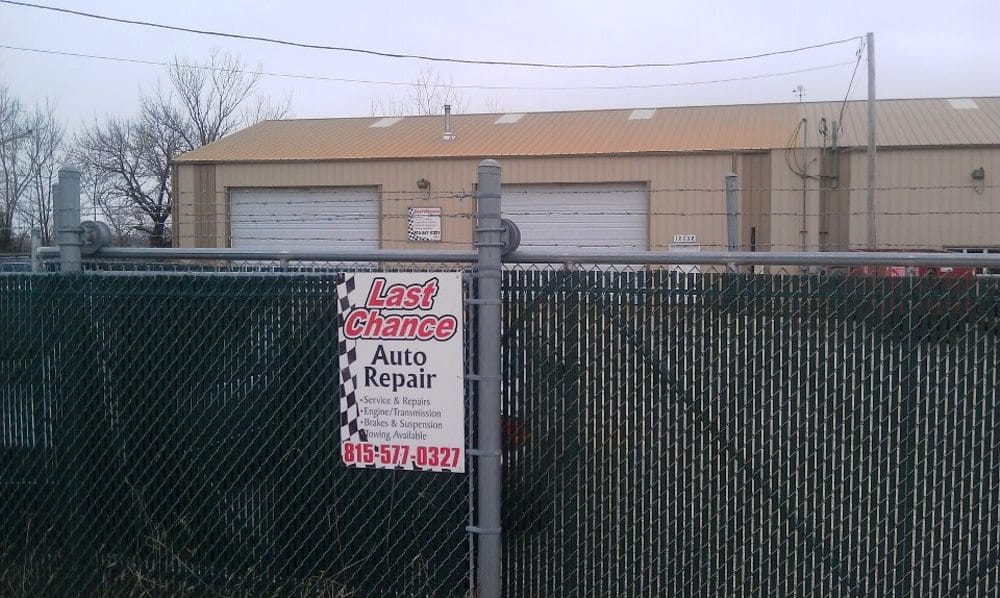
Last Chance Auto Repair

Auto Repair Shop In Plainfield, IL

Auto Repair Shop In Plainfield, IL

Auto Repair In Plainfield At Its Finest. Serving Plainfield, Naperville, Bolingbrook, Romeoville, Chicagoland since 1978.

  • Services
        • Brake Repair
          • Brakes Near Me
          • Brakes Plainfield
          • Brakes Naperville
          • Brakes Bolingbrook
          • Brake Rotor Replacement
          • Save On Brakes
        • Emissions Repair
        • Asian Repair
        • European Repair
        • Classic & Vintage
        • Truck Repair
          • Medium Duty Repair
        • Fleet Repair
        • Charging System Repair
          • Alternator Repair
          • Alternator Replacement
        • A/C Repair
          • A/C Recharge Service
          • A/C Condenser Repair
          • A/C Compressor Repair
        • Cooling System
          • Radiator Services
          • Water Pump Replacement
          • Thermostat Replacement
        • Steering System
        • Auto Maintenance
          • Auto Tune-Up
          • Oil Change
          • Batteries
        • Engine Services
          • Starter Replacement
          • Timing Belt Replacement
          • Timing Chain Replacement
          • Cylinder Heads
          • Auto Machine Shop
        • Transmissions
          • Clutch Replacement
          • Torque Converter Replacement
        • Transfer Cases
        • Carburetors
        • Driveshaft Service
        • Diesel Repair
        • Electrical Repair
        • Suspension Repair
          • Shocks & Struts
          • Ball Joint Replacement
          • Alignment Shop
        • Exhaust Repair
          • Catalytic Converter
        • Differential Repair
        • Diagnostic
        • Auto Glass Repair
        • Auto Body Shop
        • Welding Service
        • Vehicle Inspection
        • Tire Replacement
  • Vehicles
          • DOMESTIC
          • Buick Repair
          • Cadillac Repair
          • Chevrolet Repair
          • Corvette Repair
          • Dodge Repair
          • Ford Repair
          • GMC Repair
          • Hummer Repair
          • Jeep Repair
          • RAM Repair
          • ASIAN
          • Acura Repair
          • Daewoo Repair
          • Honda Repair
          • Hyundai Repair
          • Infiniti Repair
          • Isuzu Repair
          • KIA Repair
          • Lexus Repair
          • Mazda Repair
          • Nissan Repair
          • Mitsubishi Repair
          • Scion Repair
          • Subaru Repair
          • Suzuki Repair
          • Toyota Repair
          • EUROPEAN
          • BMW Repair
          • Fiat Repair
          • Jaguar Repair
          • Land Rover Repair
          • Mercedes Benz Repair
          • MINI Cooper Repair
          • Porsche Repair
          • Saab Repair
          • Smart Repair
          • Volkswagen Repair
          • Volvo Repair
  • Towing
        • 24 Hour Towing
        • Towing Plainfield
        • Towing Bolingbrook
        • Roadside Assistance
        • Lockout Service
        • Jump Start Service
        • Mobile Battery Replacement
        • Toolbox Towing
  • Storage
    • Outdoor Car Storage
  • Coupons
        • Low Cost Guaranteed
        • Transmissions
        • Free Brake Inspection
        • Air Conditioning
        • Oil Change Specials
        • Free Computer Scan
        • Teacher Discount
        • Senior Citizen Discount
  • Blog
  • About Us
    • Reviews
    • Now Hiring
    • Car Mechanic Jobs Near Me
    • Brake Repair FAQs
  • Contact Us
  • Write A Review

How Much Does A Head Gasket Repair Cost

How Much Does A Head Gasket Repair Cost

Do you know how much does a head gasket repair cost? A blown head gasket is a serious engine problem that can have been caused simply by lack of maintenance. Hence the importance of proper engine maintenance and reduce head gasket repair cost. Do you know how much a cylinder head gasket repair costs?

What Does A Blown Cylinder Head Gasket Look Like?


Common Symptoms Of A Blown Head Gasket May Include:

• White Smoke Coming Out Of Your Tailpipe • Engine Running Rough Or Misfiring

• Engine Overheating • Milky Substance In Your Oil • Oil Substance In Your Coolant

Know one wants to pay for a costly cylinder head gasket repair cost service. Maybe if you knew how much a costly cylinder head gasket repair cost service was. You’d stay on top of your motor vehicle’s preventive maintenance schedule. Is your vehicle suffering from white smoke coming out of your tailpipe? Is your engine running rough or misfiring? Does your engine overheat? If so you may have a cylinder head gasket issue.

The first step is to confirm with a trusted automotive mechanic shop. That the symptoms your vehicle is experiencing is actually caused by a blown head gasket. A cylinder head gasket repair cost can be one pretty costly service. So, you want to be 100% sure that it is indeed a blown cylinder head gasket. Once confirmed, the head gasket repair cost process is pretty straight forward. What we do over at Last Chance Auto Repair in Plainfield, IL to confirm the need to dig into the upper half of the engine is. We preform a combustion system gas analyzation test.

What Is A Combustion System Gas Analyzation Test?

If your suffering from unexplained engine overheating, a loss of coolant without visible leaks, white smoke coming out of exhaust. In addition, intermittent check engine light, poor or rough idle, you may need a combustion system gas analyzation test. Cheap, quick and easy service, but required to be sure in some cases of a blown gasket or a cracked head situation.

We typically charge a total of $50.00 for this service.

head gasket repair costA combustion system gas analyzation test can be preformed on most vehicles or basically on any type of internal combustion engine. Having a radiator, whether it’s gasoline, diesel, alcohol or liquid gas powered. Hot coolant can cause severe burns so you better let a pro perform the test, better safe than sorry. A combustion system gas test, is a test (service) we preform to determine the condition of your cylinder head. Also, cylinder head gasket, plus engine block, by trying to detect combustion chamber gases where combustion chamber gases don’t belong.

Head Gasket Repair Cost?

Well prices do vary from vehicle to vehicle, damage caused by overheating, plus all the parts that need to be replaced during service. Included in most head gasket repair services would be a head gasket kit. Also, coolant/antifreeze, thermostat, coolant/antifreeze flush plus an oil change along with the labor. In some cases, depending on how badly you overheat it.  You may also get charged for machining the cylinder head. A worst case scenario can include an unfixable cylinder head and or a damaged engine block. What is your plan?

Blown head gasket repair costs at our repair shop in Plainfield, Illinois. It typically range from between $600-$1,500 on average. I would have to say about 60% have cylinder head or engine damage. This is which can result in higher machine plus cylinder head work costs.

Sometimes the additional fee’s are bare minimum but other times an engine block. It can be so bad it is past the point of know return or a cylinder head is so warped it’s unfixable. Hence the needing of an engine replacement service or needing a cylinder head or two. Hence the importance of proper engine maintenance. Out of the 60% about 40% of the additional fee’s are bare minimum. Once again it is all about how bad it was overheated. Now 40% of people get lucky enough where all the damage is in the head gasket itself. Swap the head gasket, boom out the door it goes.

How Long Does A Typical Head Gasket Replacement Take?

Are you in Plainfield, Naperville, Bolingbrook, IL, or any of the surrounding suburbs in need of a head gasket replacement service? Look no further Last Chance Auto Repair in Plainfield is here for all your head gasket repair service needs. How can we help you?

Indications That Your Vehicle Could Be Dealing

with a Faulty Head Gasket

If you’re wondering whether your car has a blown head gasket, look out for these clear signs that indicate potential trouble.

1. Persistent White Smoke from the Exhaust:

If you notice thick, continuous white smoke coming from your exhaust pipe, it could be a sign of a blown head gasket. This occurs when coolant leaks into the combustion chamber and is burned along with fuel.

2. Engine Overheating:

An overheating engine may signal a head gasket problem and knowing in advance reduce head gasket repair cost. Keep an eye on your temperature gauge, and if it consistently reaches higher-than-normal levels, it’s time to investigate.

3. Milky Substance in Engine Oil:

Check your engine oil for a milky or frothy appearance. Also, this indicates a coolant and oil mixture, a classic sign of a compromised head gasket.

4. Coolant Loss Without Visible Leaks:

If your coolant levels are dropping, but you can’t find any external leaks. Additionally, it may suggest an internal leak through a blown head gasket.

5. Engine Running Rough or Misfiring:

A misfiring engine or a noticeable change in its performance could be attributed to a loss of compression caused by a blown head gasket.

6. Air pockets in the radiator or coolant overflow reservoir:

Examine the coolant in the radiator or overflow tank. Bubbles appearing when the engine is running may indicate combustion gases. Entering the cooling system, a potential sign of a head gasket issue.

7. Sweet Smell from the Exhaust:

A sweet smell coming from the exhaust may suggest the presence of coolant being burned in the combustion process. Also, it indicates a possible head gasket leak.

Head Gasket Repair Cost: What to Expect

If you’ve observed one or more of these signs and suspect a blown head gasket, it’s crucial to address the issue promptly. Ignoring it can lead to more extensive and costly engine damage. Moreover, head gasket repair cost can vary depending on factors like the extent of the damage. The vehicle’s make and model, along with the prevailing local labor rates.

On average, head gasket repair cost range from $600 to $1,500. This estimate typically includes the head gasket kit, coolant/antifreeze, thermostat, coolant/antifreeze flush, an oil change, and labor. Keep in mind that additional charges may apply if there’s damage. Especially to the cylinder head or engine block, necessitating further repairs.

If you’re concerned about head gasket issues or head gasket repair cost, it’s advisable to consult with a trusted mechanic. In addition, for a proper diagnosis and a detailed estimate tailored to your specific situation. Addressing the problem early can save you both time and money  from head gasket repair cost in the long run.

Head Gasket Repair Cost: Quick and Easy

Coolant/Antifreeze Flush Guide

Coolant or antifreeze is a vital fluid for your car’s engine, ensuring it runs at the right temperature and prevents freezing in colder conditions. Regularly flushing and replacing the coolant is essential for maintaining a healthy engine. Here’s a step-by-step guide in simple terms to help you keep your car running smoothly.

Step 1: Gather Your Supplies

For this simple flush, you’ll need a few basic tools: a coolant catch pan, a funnel, a mix of distilled water and antifreeze, and safety gear like gloves and safety glasses.

Step 2: Locate the Radiator Drain Valve

Underneath the radiator, find the drain valve. It usually looks like a small spigot or a petcock. Place the catch pan under it to collect the old coolant.

Step 3: Open the Radiator Cap

Release any pressure in the system by carefully opening the radiator cap. Be cautious, as the coolant might still be hot. Once it’s safe to proceed, unscrew and remove the cap.

Step 4: Drain the Old Coolant

Turn the drain valve counterclockwise to allow the old coolant to flow out into the catch pan. Be patient, as it may take some time for all the coolant to drain.

Step 5: Flush with Water

Close the drain valve once the old coolant has drained. Additionally, fill the radiator with a mixture of distilled water and coolant as per your vehicle’s specifications. Start the engine and let it run for a few minutes to circulate the mixture.

Step 6: Repeat the Process

Repeat the draining process until the liquid coming out is clear, indicating that the system is free of old coolant and debris.

Step 7: Fill with New Coolant

Once the system is thoroughly flushed, fill the radiator with the recommended coolant and water mixture. Moreover, make sure it reaches the appropriate level.

Step 8: Bleed the System

Start the engine with the radiator cap off and let it run until the thermostat opens. This permits the release of air from the system. Also, keep an eye on the coolant level and add more if needed.

Step 9: Replace the Cap

Once the system has been bled and the coolant level is stable, replace the radiator cap securely.

Tagged With: head gasket, head gasket repair, head gasket repair bolingbrook, head gasket repair cost, head gasket repair naperville, head gasket repair plainfield, head gasket repair shop, head gasket replacement, what does a blown head gasket cost to fix

Tips For Buying A Used Car

Tips For Buying A Used Car

Are you looking for a used car? Do you need to buy your kid their first car? Buying a used car is a lot more complicated than buying a new one. How do you know if it is worth buying?

Here is a quick breakdown of tips for buying a used vehicle. Make sure to ask the proper questions, you don’t want to get stuck with a lemon. Stop by for an inspection.

• Look For Rust
• Look For Leaks
• Listen For Noises
• Any Engine Problems
• Get Vehicle Inspected
• Is Your Engine Burning Oil
• Buy Single Owner Vehicles
• Inspect Maintenance Records
• Give Us A Call If You Have Any Questions

Pre-Purchase Auto, Used Car, Classic Car,

Truck, RV & Motorhome Inspections

Are looking for an auto repair shop that offers a comprehensive used car & light truck pre-purchase vehicle inspection service? Our team offers full body, interior, options, test drive, frame, full mechanical plus electrical inspection services for just about any vehicle.

Need a used vehicle inspection service in Plainfield, Naperville, Bolingbrook, IL?

Here is a few tips that may be of use on your decision of bringing a new used vehicle home. Buy single owner cars, Inspect maintenance records, Look for leaks, Listen for strange noises, Look for hiding rust, Check for engine problems, Is the engine burning oil, etc. Better safe than sorry get a vehicle inspection service. If they won’t allow you to bring the vehicle to a local repair shop for a pre purchase inspection ask why, be careful! Team Last Chance Auto Repair in Plainfield, IL is here for all of your motor vehicle pre-purchase inspection service needs.

What Is The Vehicle’s Real Mileage?

One of the biggest worries about a high-mileage vehicle is the odometer rollback. This is where the seller rolls back the odometer of the car indicating a lower mileage.

You can quickly judge a car’s life by looking at its odometer, but, there are a number of other things to look for when buying a second hand vehicle, especially one with high mileage. So what all this means is don’t shy away from used autos with high miles. Used vehicles can save one thousands upon thousands of dollars in the long run, if the money is invested in the proper vehicle. Cars these days are far more reliable than older cars used to be back in the day and can run for 200,00+ miles. Need help making your engine last? Call today.

Is The Engine Burning Oil?

It’s really nice to know before you buy a vehicle if the engine is burning oil. It’s not uncommon for vehicles to burn oil but still run well. Is your oil level low between oil changes?

As engines wear, oil makes an escape. A little oil added now and then is nothing to worry over, but adding a quart or more between oil changes, you may have an oil consuption problem. Now sometimes burning oil problems are fixable without a costly engine rebuild. Burning oil thanks to worn piston rings where in some cases can be cleaned with a special carbon cleaning service. Your engine could also be leaking oil thanks to a bad gasket or cracked part. Or one of your worst case most expensive scenario’s you could be losing oil through a head gasket into the cooling system. Regardless you need to know before you buy.

Does It Have A Worn Interior?

A car’s interior can also tell quite a bit about its age. Wear and tear on the seats can expose potential odometer rollback, vehicle abuse, so pay attention to the condition of the car’s interior. Look for rust marks on the carpet. Look around pretend your a detective. Look for water stain’s which could be due to flooding. Which is a major used car killer.

More Coming Soon!

Tagged With: auto inspection, automotive inspection, car inspection, funny noises, how many owners, inspect maintenance records, pre purchase auto inspection, pre purchase car inspection, tips on buying a used car, used car inspection

When Is The Best Time To Change Your Fluid?

When Is The Best Time To Change Your Fluid?

Mileage, Time, Or Condition? When is the best time to change your fluids? Does it depend on your driving? What category would you say your in, normal or severe?

• Coolant
• Engine Oil
• Brake Fluid
• Differential Fluid
• Transmission Fluid
• Transfer Case Fluid
• Power Steering Fluid

 • Vehicle Maintenance Services Complete

Normal or Severe? Have you ever tried to actually read your owner’s manual, especially the part about maintenance and service? As if this kind of stuff isn’t confusing enough, there are always two schedules listed, one for a vehicle driven under “normal” conditions and another for “severe” conditions. But what exactly does this mean? Changing your oil and filter is the most important maintenance you can perform on your car or truck.

Changing Your Car Engine Oil In Plainfield, IL

Q: Do you know how often to change your oil?

A: Typically every 3,000-10,000 miles depending on type of oil your vehicle requires. When do you change yours?

Q: Do you know what kind of oil your vehicle likes?

A: Vehicles typically require a certain type of oil. So many different brands and types to choose from. Premium conventional oil, full synthetic oil, synthetic blend oil, higher mileage oil, many choices.

Q: What are oil additives? What do oil additives do?

A: Use of oil additives is a way to improve plus maintain your engine oil performance. High engine temperatures combine with moisture, combustion byproducts (including unburned gasoline), rust, corrosion, engine wear particles and oxygen to produce sludge and varnish. Oil additives not only assist oil in maintaining good lubrication, they also help minimize sludge plus varnish, and any damage from their formation. Here is some information about key oil additive ingredients and why they’re so important:

• Oil Additives Plus Their Importance:

• Viscosity-index improvers: Reduce oil’s tendency to thin with increasing temperature.

• Detergents: Unlike your household type, they don’t scrub engine surfaces. They do remove some deposits, primarily solids. But their main purpose is to keep the surfaces clean by inhibiting the formation of high-temperature deposits, rust and corrosion.

• Dispersants: Disperse solid particles, keeping them in solution, so they don’t come together to form sludge, varnish and acids. Some additives work both as detergents and dispersants.

• Antiwear agents: There are times when the lubricating film breaks down, so the antiwear agents have to protect the metal surfaces. A zinc and phosphorus compound called ZDDP is a long-used favorite, along with other phosphorus (and sulphur) compounds. If you musts know, ZDDP stand for zinc diakyl dithiophosphate.

• Friction modifiers: These aren’t the same as antiwear agents. They reduce engine friction and, so, can improve fuel economy. Graphite, molybdenum and other compounds are used.

• Pour-point depressants: Just because the 0° F viscosity rating is low doesn’t mean the oil will flow readily at low temperatures. Oil contains wax particles that can congeal and reduce flow, so these additives are used to prevent it.

• Antioxidants: With engine temperatures being pushed up for better emissions control, the antioxidants are needed to prevent oxidation (and, therefore, thickening) of oil. Some of the additives that perform other functions also serve this purpose, such as the antiwear agents.

• Foam inhibitors: The crankshaft whipping through the oil in the pan causes foaming. Oil foam is not as effective a lubricant as a full-liquid stream, so the inhibitors are used to cause the foam bubbles to collapse. Resulting in better lubricating qualities and reduced engine wear. 

• Rust-corrosion inhibitors: Protect metal parts from acids and moisture, which your engine could not live without. Without it your car engine would never last.

Changing Transmission Fluid In Plainfield, IL

Q: How often is your transmission fluid suppose to be changed?

A: You ever here someone say it isn’t necessary to service your transmission? Some owner’s manuals even say it isn’t necessary. Yeah, right. That’s why transmission shops like us are making a fortune replacing burned out automatic transmissions. For optimum protection, change your fluid and filter every 30,000 miles (unless you have a newer vehicle that is filled with Dexron III or any other type of ATF which is designed to be good for higher mileage).

Q: Do you know what kind of transmission fluid your vehicle takes?

A: So many kinds to choose from. ATF+4 Most Dodge, Jeep, and Chrysler | Mercon V – Most Ford, Mercury, Lincoln | Mercon LV – Some Ford(DuratecHE), MAZDA in Europe or Asia | Dexron VI – Most GM and pre-2004 Toyota products, some Ford applications | ATF DW-1 – All Honda and Acura (except CVT) | SP-III – All Hyundai, Mitsubishi and Kia (except CVT and dual clutch) | Matic S, Matic K, Matic D – Jatco transmissions, used in Nissan and Subaru vehicles | Toyota ATF-WS – All 2004 and later Toyota including hybrids, Choose wisely. Using an incorrect transmission fluid type can result in a huge hole in your pocket other wise known as transmission failure. Not worth the risk of damaging your trans. If your going to top off your trans make sure you put the correct type in. Questions about what type to use? Give us a call.

Changing Brake Fluid In Plainfield, IL

Adding brake fluid is usually not part of routine vehicle maintenance. If you have low brake fluid, typically it means that your brake pads are low and soon need to be replaced.

Q: Are there different types of brake fluid?

A: As with most fluids, there are a few different options. Including DOT 3, DOT 4, and DOT 5. DOT 3 meets a minimum specification, while DOT 4 and  5 meet more stringent requirements. The purpose of these requirements is “to  reduce failures in the hydraulic brake systems. (1) Petroleum (mineral oil) base (2) Non petroleum base. Types of brake fluid are differentiated based on their boiling capacity.

Warning: Never use DOT 5 automotive brake fluid in a vehicle designed for DOT 3 or DOT 4 fluids. It is ok to use DOT 4 fluid in a vehicle that requires DOT 3, but not vice-versa. NEVER substitute any other fluid for brake fluid. Wash your hands after coming in contact with brake fluid. It eats paint, so imagine what it’ll do to skin. Properly discard brake fluid that’s been unsealed for more than one year. Make your brake repair service last, use proper fluid.

Coolant Flushing In Plainfield, IL

Q: How many different types of automotive coolant are there?

A: Hybrid engine coolants (containing silicates), OAT engine coolants (free of silicates), Si-OAT-engine coolants

Q: How often should coolant be changed?

A: Engine coolant additives such as a pH buffer gradually breakdown and become less effective. We therefore recommend a complete change of coolant every three to four years. It’s recommended to clean your cooling system and completely renew the coolant whenever a repair is made to the cooling system. This prevents rust, soil and or suspended particles left behind in the system from causing scale, corrosion and other damage.

 Purpose Of Coolant-Antifreeze

Today’s engines are loaded with aluminum components: cylinder heads, water pumps, manifolds, even engine blocks are made from your all mighty aluminum. The two primary heat exchangers also known as a radiator and heater core are also aluminum. Aluminum needs great corrosion protection to survive, and the corrosion protection in green and red antifreeze is used up in about two years. Orange offers longer life, but if your car came with green or red, you can’t switch to orange without a fair amount of preparation. If your car is around four years old or so, a switch is not likely to yield long term coolant life, you’d still face the usual 2-year flush, drain, fill, schedule. Have any questions? Call 815-577-0327 today.

Is Your Vehicle Due For A Fluid Service?

If your in or around Plainfield, Naperville, Bolingbrook, in need of a vehicle fluid service we have all your needs covered. What fluids does Last Chance Auto Repair service? We service engine oil, transmission fluid, differential fluid, transfer case lubricants, engine coolant, power steering fluid plus brake fluid. Anything we forgot automotive related, bring it by and will service it’s fluid to. Problems or issues? Contact us anytime.

Tagged With: changing brake fluid, changing engine oil, changing transmission fluid, coolant flushing, differential fluid replacement, flushing power steering system, transfer case fluid service

  • « Previous Page
  • 1
  • …
  • 68
  • 69
  • 70
  • 71
  • 72
  • …
  • 77
  • Next Page »

Reviews

[RICH_REVIEWS_SHOW category=”Auto Repair In Plainfield” num=”3″]
[RICH_REVIEWS_SNIPPET category=”all”]

Facebook Posts

Last Chance Auto Repair For Cars Trucks

1 week ago

Last Chance Auto Repair For Cars Trucks
Need a reliable car mechanic?

... See MoreSee Less

Zayden cross gave Last Chance Auto Repair For Cars Trucks 5 stars. Check out the full review...

www.trustpilot.com

Honest and reliable car mechanic shop in Plainfield that includes reasonable prices and great w ...
View on Facebook
· Share

Share on Facebook Share on Twitter Share on LinkedIn Share by Email

Last Chance Auto Repair For Cars Trucks

1 week ago

Last Chance Auto Repair For Cars Trucks
Need a car repair near me?

... See MoreSee Less

Zyen Calder gave Last Chance Auto Repair For Cars Trucks 5 stars. Check out the full review...

www.trustpilot.com

A prime example of a local family owned and operated business. I'm all about supporting local a ...
View on Facebook
· Share

Share on Facebook Share on Twitter Share on LinkedIn Share by Email

Last Chance Auto Repair For Cars Trucks

1 month ago

Last Chance Auto Repair For Cars Trucks
Are you a mechanic looking for a new home, more money, respect? Last Chance Auto Repair is hiring! ... See MoreSee Less

This content isn't available right now

When this happens, it's usually because the owner only shared it with a small group of people, changed who can see it or it's been deleted.
View on Facebook
· Share

Share on Facebook Share on Twitter Share on LinkedIn Share by Email

Best Auto Repair Shop in Plainfield, IL

Recent Posts

  • Do Auto Repair Shops in Plainfield Provide Diagnostic Services?
  • How Often Should I Visit an Auto Repair Shop in Plainfield?
  • How Long Does a Typical Auto Repair Take in Plainfield?
  • What Makes a Trusted Auto Repair Shop in Plainfield Stand Out?
  • Why Choose a Certified Auto Repair Shop for Repairs?

Contact Us

12052 S Naper Plainfield Rd
Plainfield, IL 60585
(815) 577-0327
info@lastchanceautorepairs.com

Contact Us

12052 S Naper Plainfield Rd
Plainfield, IL 60585
(815) 577-0327
info@lastchanceautorepairs.com

Service Area

Plainfield, 60585, 60544, 60586, Naperville, 60564, Bolingbrook, 60490, 60440, Romeoville, 60446, Will, Kendall, DuPage, Counties. Our auto repair shop in Plainfield, IL, has been serving the local area plus all surrounding Chicagoland since 1978.

Learn About Naperville, IL

Learn About Plainfield, Illinois

Specialties

• Computer Diagnostic • Brake Shop • Engine Replacement • Transmission Rebuild • Clutch Replacement • Differential Rebuild • Suspension Shop • Steering • Shocks & Struts • Heating & Cooling • Electrical • Exhaust Shop • Catalytic Converter Replacement • Alignment • Domestic & Foreign Vehicle Service • Auto Repair In Plainfield, IL • Auto Repair Shops Near Me • Towing Service Near Me

Last Chance Auto Repair In Plainfield, IL | Copyright © 1978 - 2026 | All Rights Reserved | (815) 577-0327